



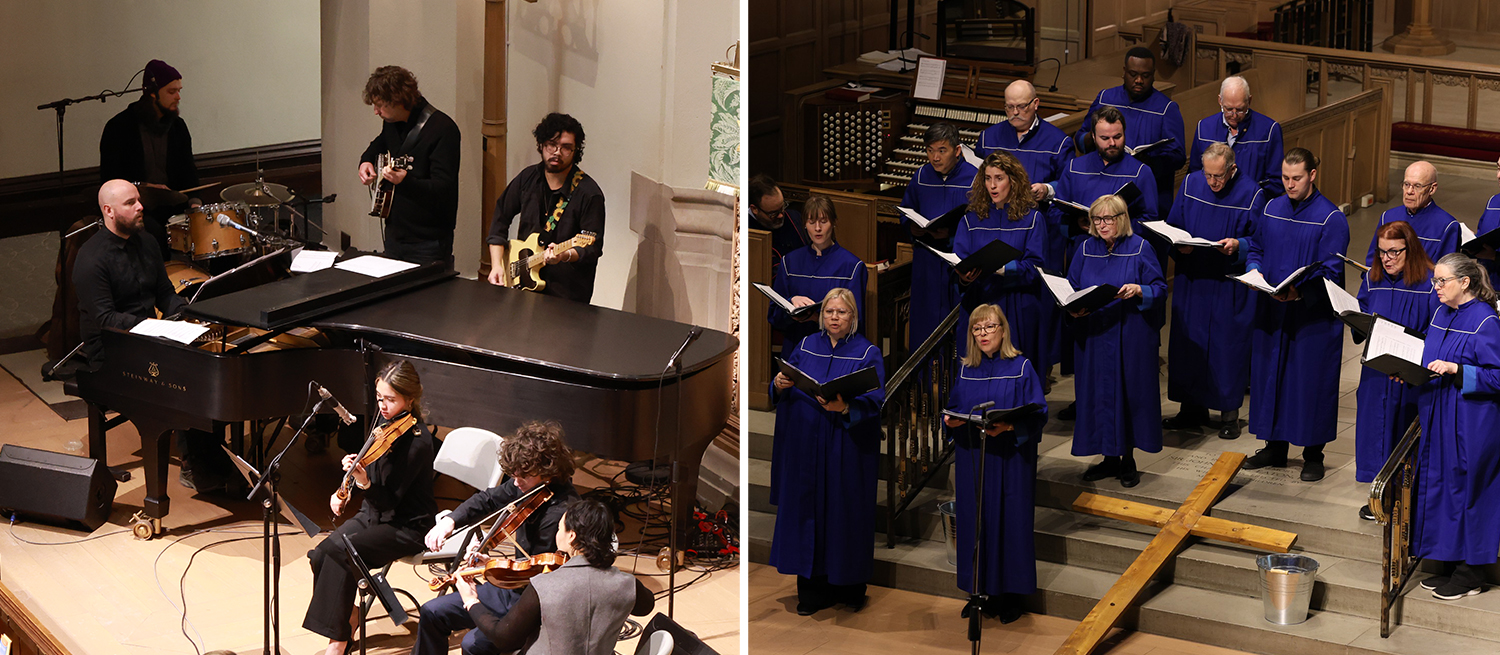
What should we call our two worship services?
Right now we call them “contemporary,” at 9:15, and “traditional” at 11. The “contemporary” label is a bit wobbly. We have a band at that service, with a guitar and bass and strings section and often a banjo these days. But we also have our chancel choir, which is a general no-no with “contemporary” worship. Sometimes they even sing in Latin, as they did last Sunday. Clergy don’t wear robes, we invite children up to the front for a blessing and then Sunday School, we preach from the top of the steps, but otherwise, it’s a pretty traditional service.
Our 11 o’clock service might earn its name better, with procession and recession of clergy and choir, both berobed, our organ playing, nary a guitar in sight. But even so it has “contemporary” touches, with our screens and occasional applause.
If you’re confused, join the club.
“Contemporary” worship arose in the 1980s and 90s as a sort of alternative to what was taken to be boring and pretentious chorale and organ music. The effort was to make church more like a trip to the mall, or any other approachable activity for middle-class suburbanites. It had older roots in 1960s and 70s folk music, given a Jesus twist with revivals among young people at the time. But the goal was to make music recognizable to those who like easy-listening channels on the radio. And it worked. Services featuring such music, especially in evangelical contexts in North America, grew, while robed and choired services shrank. These generalizations have exceptions, of course. But “contemporary” music is its own tradition now. Think 3-4 praise songs, a long sermon, one or two more praise songs, and you’re done. That’s a routine, a liturgy even—an expected set of social mores that guide a group’s behaviour. You even have contemporary music purists who insist the formula can’t be changed. You know, this formula we came up with ten minutes ago.
“Traditional” music may not go back as far as you think either. The hymns we sing sometimes date from the 16th or 17th century, but hymn-singing in church only became standard in the 19th century. Before that, Methodists in England got in trouble for “interrupting” Anglican church services with their hymns. 19th century hymns that we still sing powered evangelical revivals across the Americas and beyond—we’ll sing “Just As I Am” Sunday, which was a mainstay of Billy Graham’s revivals. But the form of worship we think of as “traditional” may date more from the 1950s than we realize. Tall steeple churches like ours, influenced by the ecumenical movement, draw on early church forms, modern hymnody, and early modern instruments like the organ.
Now these two terms exist in a kind of binary opposition—we only know what one is by not being the other. But our two services aren’t so different as all that. Same singers, same preachers, some of the same instruments. Could we call them something different, something more accurate?
Some evangelicals, especially in England, now use the descriptor “band-led” for what we call “contemporary.” One friend’s similar church to ours called their contemporary service “Something . . . different,” and their traditional “Something . . . classic.” I’ve wondered if we could draw on the language of Psalm 150 and call 9:15am “Strings and voice,” referring to guitars and violins, and 11am “Strings and pipes” for piano and organ. You see the problem—no one would know what we meant. So we maintain “contemporary” and “traditional,” as much as they misdescribe, because the alternatives are worse.
At our Songs of Love and Passion event recently, I marveled at how our choir leads normally wear stage black on Sundays, but once a year, on Valentines, they dress as fabulously as they want, and sing love songs over candlelight. We could call it “sexy church.” That would contrast with Sunday’s usual fare, which we might call “chaste church.” Despite its dour reputation, chastity is a great thing—a promise to relate to someone else without sexual acquisitiveness should mark all but one of our relationships. But I digress.
To be honest I don’t care what we call the services. I converted to guitar chords and my heart thrills to banjo, so more of this. The hymns on our organ and our choir’s anthems are some of the great songs on planet earth, so more of this. The worship wars are effectively over, no one is yelling at the other that this or that genre is essentially bad. But we do need to call them something, for internal and external purposes both. The question is . . . what?